 Image 1 of 1
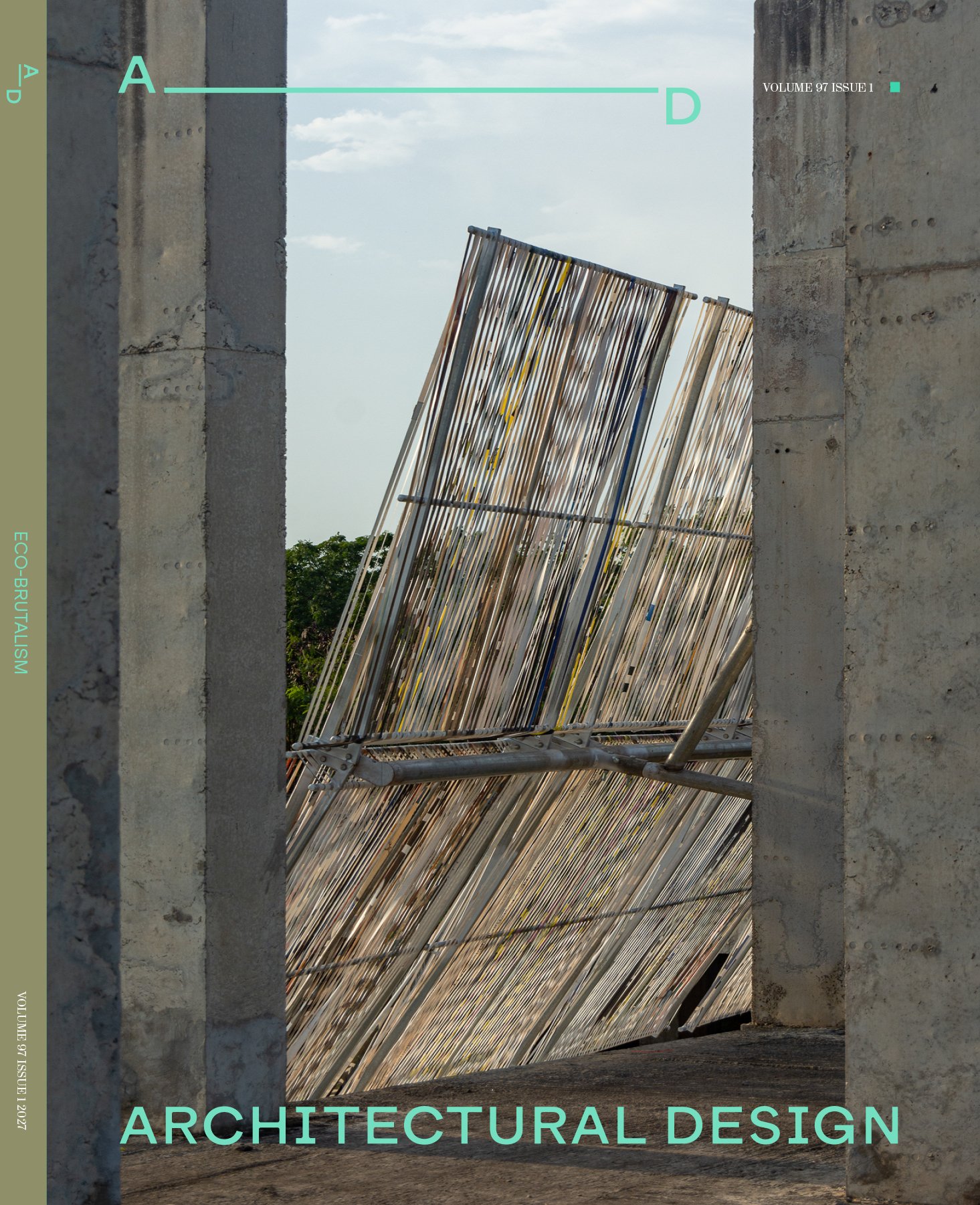
Guest edited by Vanessa Grossman and Owen Hopkins
“Eco-Brutalism” is an emerging architectural approach that reconnects the bold social vision of 1960s and 1970s Brutalism and New Brutalism with contemporary environmental challenges. Once dismissed and now reconsidered, Brutalism reflects an era of cheap energy and high carbon intensity. This issue of A—D explores how its expressive clarity and material honesty can engage natural systems, making environmental processes legible in design—from the mechanics of a building to the scale of landscape and infrastructure—and how it can inform low-carbon architecture with comparable ambition. Rather than focusing solely on materials such as timber, stone, or new bio-based alternatives, it examines the architectural languages and practices these materials enable, alongside new approaches to concrete. Part exploration, part manifesto, and part historical inquiry, the issue brings together practitioners, critics, and historians from across the globe to advance design thinking with the urgency, radicalism, and transformative spirit that once defined Brutalism itself.
CONTRIBUTORS
Letícia Wouk Almino, Caio Calafate, Jeanne Gang, Emanuele Coccia, Corentin Fivet, Maxence Grangeot, Béatrice Grenier, Lewis Jones, Rami Kanafani, Guy Nordenson, Dominique Petit-Frère, Søren Pihlmann, Bart-Jan Polman, Catherine Seavitt, Adam Sharr, Pedro Varella, Vo Trong Nghia, Jianfei Zhu, Taller Gabriela Carrillo, Lütjens Padmanabhan
Guest edited by Vanessa Grossman and Owen Hopkins
“Eco-Brutalism” is an emerging architectural approach that reconnects the bold social vision of 1960s and 1970s Brutalism and New Brutalism with contemporary environmental challenges. Once dismissed and now reconsidered, Brutalism reflects an era of cheap energy and high carbon intensity. This issue of A—D explores how its expressive clarity and material honesty can engage natural systems, making environmental processes legible in design—from the mechanics of a building to the scale of landscape and infrastructure—and how it can inform low-carbon architecture with comparable ambition. Rather than focusing solely on materials such as timber, stone, or new bio-based alternatives, it examines the architectural languages and practices these materials enable, alongside new approaches to concrete. Part exploration, part manifesto, and part historical inquiry, the issue brings together practitioners, critics, and historians from across the globe to advance design thinking with the urgency, radicalism, and transformative spirit that once defined Brutalism itself.
CONTRIBUTORS
Letícia Wouk Almino, Caio Calafate, Jeanne Gang, Emanuele Coccia, Corentin Fivet, Maxence Grangeot, Béatrice Grenier, Lewis Jones, Rami Kanafani, Guy Nordenson, Dominique Petit-Frère, Søren Pihlmann, Bart-Jan Polman, Catherine Seavitt, Adam Sharr, Pedro Varella, Vo Trong Nghia, Jianfei Zhu, Taller Gabriela Carrillo, Lütjens Padmanabhan